You love the pure strategy of chess. The outthinking, the planning, the satisfaction of a well-executed trap. But maybe you’re tired of the same openings, or your skill gap with friends makes games one-sided, or you simply want something fresh that scratches the same itch.
The Quick Answer: The best strategy games like chess include Hive, Onitama, Santorini, Go, and The Duke, all offering chess-level strategic depth with different mechanics that keep things fresh. If you want zero-luck abstract strategy, these are the closest relatives to chess available. If you’re open to slightly lighter games that still reward the same kind of thinking, options like Azul or 7 Wonders Duel hit that sweet spot.
I’ve been playing abstract strategy games for over fifteen years, and I’ve introduced dozens of chess players to alternatives that genuinely captured their imagination. After testing and comparing more than 30 chess-like board games, here are the ones that consistently win converts.
What Makes a Good Strategy Game Like Chess?
Before diving into the list, let’s define what chess players typically want from a chess alternative:
- No luck, Winning should come from better play, not dice rolls or card draws
- Perfect information, Both players see everything; no hidden elements
- Deep strategy, Simple to learn, lifetime to master
- Meaningful decisions, Every move should matter
- Quick to set up, No elaborate preparation required
Some games on this list are pure abstracts like chess. Others bend the rules slightly, adding cards or asymmetric setups, while maintaining the strategic depth that chess players crave. If you’re still learning the fundamentals, our complete guide to chess rules for beginners is a great starting point before exploring alternatives.
The Best Strategy Games Like Chess (Ranked)
1. Hive: Best Overall Chess Alternative

2 Players | 20 min | No board, no luck, pure positioning
Hive might be the closest thing to "chess evolved."
Hive might be the closest thing to “chess evolved.” You’re placing hexagonal insect tiles around a central hive, trying to surround your opponent’s queen bee while protecting your own. There’s no board, the pieces themselves create the play area, constantly shifting and growing.
Each insect has unique movement rules reminiscent of chess pieces. The queen moves one space (like a king). The beetle can climb on top of other pieces. The ant can move anywhere around the hive’s edge. The grasshopper jumps in straight lines.
What makes Hive special is how the “board” evolves. Unlike chess, where the battlefield stays constant, Hive’s shape changes dramatically. A piece that seemed trapped suddenly has escape routes as new pieces create new edges. It rewards both tactical awareness and long-term planning.
Best for: Chess players who want something portable and deeply strategic. The bakelite pieces are nearly indestructible and fit in a small bag. The Hive Carbon edition is particularly elegant.
2. Onitama: Best Chess-Like for Quick Games

2 Players | 15 min | Chess-like setup with constantly rotating moves
Onitama is what happens when you take chess and add a brilliant twist: instead of fixed piece movements, you choose moves from a hand of cards, and after using a card, you must pass it to your opponent.
Onitama is what happens when you take chess and add a brilliant twist: instead of fixed piece movements, you choose moves from a hand of cards, and after using a card, you must pass it to your opponent.
The 5×5 board has each player starting with a master (the “king”) and four students (pawns). You win by capturing the opponent’s master or moving your master to their starting square. Simple enough. But here’s the catch: only five movement cards are in play each game, and they rotate between players.
This creates fascinating dynamics. You can see exactly which moves your opponent will have in two turns. You can set up traps knowing they’ll gain access to the exact card you need them to have. It’s chess-like positional play combined with hand management, and every game plays differently because of the random card selection.
Best for: Chess players who want something faster with high replayability. The box transforms into the game board, making it perfect for travel.
3. Santorini: Best Chess-Like for Beginners

2-4 Players | 20 min | Spatial reasoning meets vertical strategy
Santorini asks you to think in three dimensions.
Santorini asks you to think in three dimensions. On a 5×5 grid, you move one of your workers and then build a tower level adjacent to them. First player to stand on a third level wins. Simple rules, extraordinary depth.
The beauty is in the blocking. You can cap a tower to prevent anyone from winning on that space. You can trap opponents by building around them. You can create staircases only you can climb while denying paths to others.
For an extra layer, the game includes god power cards that give each player a unique ability, like moving workers extra spaces or building before moving. These add variety but can be left out for a pure abstract experience that’s very chess-like in its cleanness.
Best for: Chess players who want something visually striking that plays quickly but rewards repeated play. Also excellent for teaching non-chess players.
4. The Duke: Best for Chess Players Who Hate Memorized Openings
2 Players | 30 min | Chess meets randomized setup and flipping pieces
The Duke takes chess's core concept, different pieces with different movements, and makes it dynamic.
The Duke takes chess’s core concept, different pieces with different movements, and makes it dynamic. Each tile shows movement patterns on both sides, and every time you move a piece, you flip it to reveal new capabilities.
Instead of a fixed starting position, you draw tiles from a bag and place them as you go. This eliminates opening theory completely while maintaining deep tactical play. Your Pikeman moves differently after attacking. Your Wizard teleports but then becomes a simple stepper.
Win by capturing your opponent’s Duke (their king equivalent). The game creates situations where a seemingly weak piece becomes powerful after flipping, or a dominant piece becomes vulnerable. It rewards memory, planning, and adapting to chaos.
Best for: Chess players frustrated by opening memorization who want pure tactical thinking without months of study.
5. Go: The Deepest Strategy Game Like Chess

2 Players | 30-90 min | The deepest abstract game in existence
If chess is the king of Western strategy games, Go is its Eastern counterpart, and arguably deeper.
If chess is the king of Western strategy games, Go is its Eastern counterpart, and arguably deeper. On a 19×19 grid, players alternate placing stones, trying to surround territory and capture opponent’s pieces.
The rules are simpler than chess. You place a stone; if you surround enemy stones, you capture them. That’s essentially it. Yet from these simple rules emerges complexity that makes chess look modest. The number of possible Go positions exceeds the number of atoms in the observable universe.
Go develops different skills than chess. It emphasizes influence over territory, whole-board thinking over local tactics, and intuition developed over thousands of games. Many chess masters have called it the ultimate strategy game.
Best for: Chess players ready for a lifetime journey into a new strategic universe. Start on a smaller 9×9 or 13×13 board before attempting the full 19×19.
6. Shogi: Japanese Chess with a Brilliant Twist

2 Players | 30-60 min | Captured pieces switch sides and rejoin the fight
Shogi is the Japanese cousin of chess, played on a 9×9 board with pieces that move in ways chess players will find familiar.
Shogi is the Japanese cousin of chess, played on a 9×9 board with pieces that move in ways chess players will find familiar. But the game-changing mechanic is this: when you capture an opponent’s piece, it becomes yours. You can place it back on the board on any future turn, fighting for your side.
This single rule transforms everything. Games never simplify the way chess does. There are no “dead draws” from piece exchanges, every capture gives you more options, not fewer. The endgame is often more complex than the opening because both players have a growing army of captured pieces to deploy.
Shogi has a massive competitive scene in Japan, with professional players earning significant salaries. The strategic depth rivals chess, and many chess grandmasters have praised it as an equally challenging intellectual pursuit.
Best for: Chess players who want the closest tactical experience to chess but with more dynamic, aggressive gameplay. Expect steeper learning curve than lighter alternatives on this list.
7. Shobu: Most Unique Chess-Like Game

2 Players | 30 min | Simple rules, complex positional play
Shobu uses four small boards, two per player, with identical starting positions of four stones each.
Shobu uses four small boards, two per player, with identical starting positions of four stones each. On your turn, you make a “passive” move on one of your home boards, then must make the same move (direction and distance) as an “aggressive” move on a different board.
Aggressive moves can push opponent stones, potentially knocking them off the board. Push all four of someone’s stones off any single board, and you win.
The mirrored movement creates puzzles where what’s good on one board might be disastrous on another. You’re essentially playing four chess games simultaneously, with your moves linked. It sounds confusing but becomes intuitive quickly.
Best for: Chess players who enjoy positional maneuvering and can hold multiple situations in their head.
8. Azul: Best Chess-Like Game for Mixed Groups

2-4 Players | 30-45 min | Abstract pattern building with vicious blocking
Azul isn't quite a pure abstract, there's a drafting mechanism with some information hidden at game start, but it scratches similar itches.
Azul isn’t quite a pure abstract, there’s a drafting mechanism with some information hidden at game start, but it scratches similar itches. You’re drafting colored tiles from a shared pool to build patterns on your player board.
The strategic depth comes from hate-drafting. Taking tiles your opponent needs, forcing them into bad positions, reading their board to anticipate their plans. The best Azul players are thinking several rounds ahead, just like chess.
Unlike chess, Azul doesn’t require years of study to enjoy. Players can jump in immediately while still finding depth over many plays.
Best for: Chess players looking for something their non-chess-playing friends will also enjoy.
9. Quoridor: Simplest Rules, Biggest Payoff

2-4 Players | 15 min | Racing and blocking on an ever-changing maze
Each player has a pawn trying to reach the opposite side of a 9×9 grid.
Each player has a pawn trying to reach the opposite side of a 9×9 grid. On your turn, you either move your pawn one space or place a wall segment. You can’t completely block an opponent’s path, but you can make it very, very long.
Quoridor is about path efficiency, making your route shorter while lengthening theirs. Wall placement becomes critical: spend walls too early and you’re defenseless; hoard them and you fall behind. Games often come down to single-turn differences.
The rules take 30 seconds to explain. The implications take months to explore. Quoridor is pure spatial reasoning with just enough wall-placement strategy to create fascinating decisions.
Best for: Chess players who want something extremely quick that kids and adults can enjoy together.
10. YINSH: Best Chess-Like from the Abstract Masters

2 Players | 30 min | Part of the GIPF series, designed for abstract strategy lovers
YINSH is from Kris Burm's GIPF Project, a series of abstract games that are each brilliant in different ways.
YINSH is from Kris Burm’s GIPF Project, a series of abstract games that are each brilliant in different ways. In YINSH, you move rings and flip the markers they jump over, trying to form rows of five of your color.
Here’s the twist: when you complete a row, you remove those markers and one of your rings. First player to remove three rings wins. But rings are your only means of movement. The game becomes about timing, building toward rows while keeping enough pieces to finish the job.
It’s deceptively simple looking but creates agonizing decisions as the board state evolves. Games shift dramatically as players sacrifice rings, changing what’s possible. The entire GIPF series deserves attention from anyone who loves chess-like board games.
Best for: Chess players interested in exploring the world of modern abstract strategy games.
11. 7 Wonders Duel: Best Chess-Like with a Theme
2 Players | 30 min | Strategic card drafting with multiple paths to victory
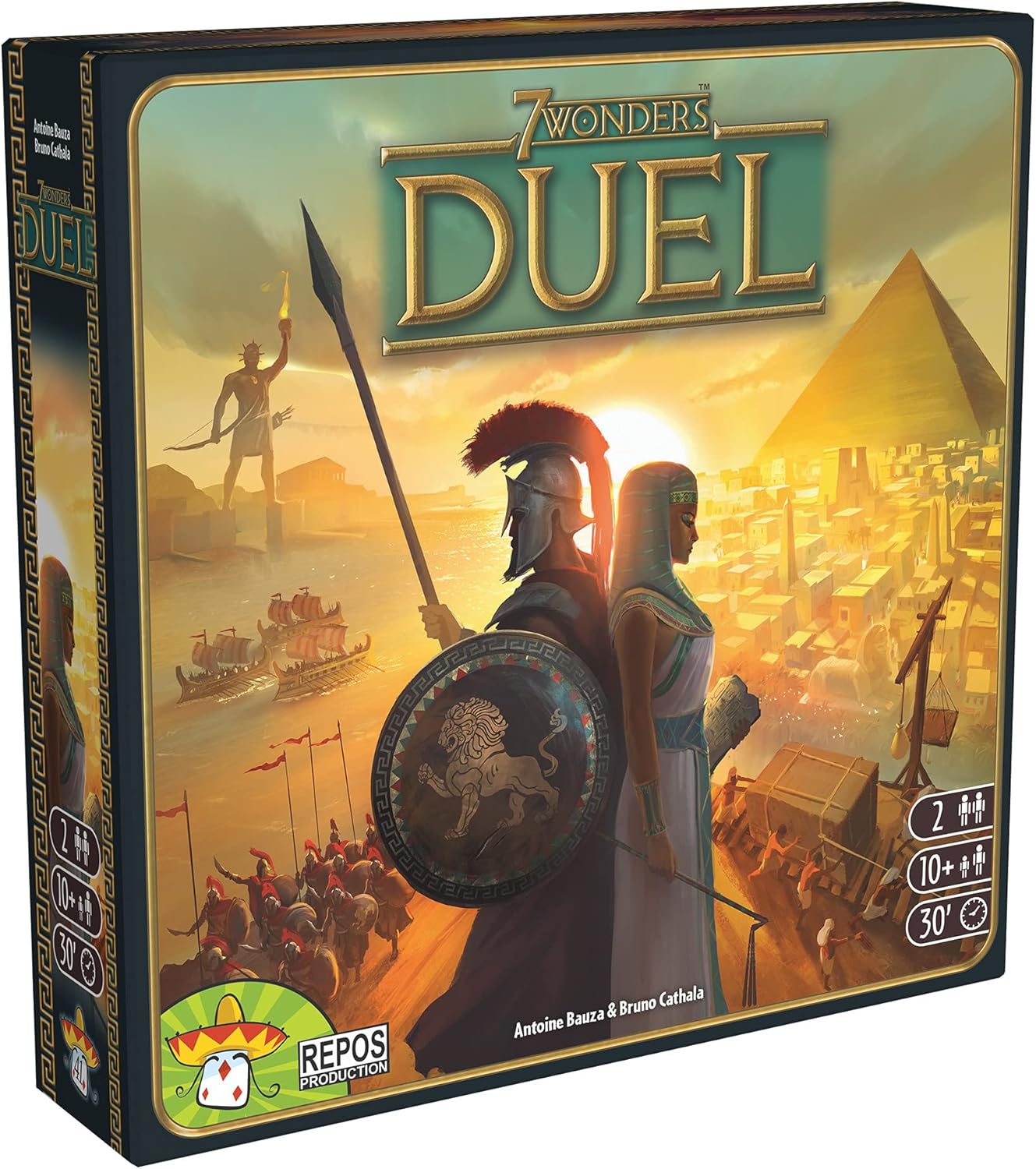
This one bends our "pure strategy" criteria, there's randomness in card layout, but 7 Wonders Duel rewards chess-like thinking so consistently that it deserves inclusion.
This one bends our “pure strategy” criteria, there’s randomness in card layout, but 7 Wonders Duel rewards chess-like thinking so consistently that it deserves inclusion.
You’re building ancient civilizations by drafting cards from a shared pyramid. You can win three ways: military dominance, scientific supremacy, or most points. The card pyramid means you can see what’s coming and plan several turns ahead.
What chess players appreciate is the blocking. Taking a card your opponent needs matters as much as what you build. The multiple victory conditions create tension as you balance offense and defense across different fronts.
Best for: Chess players who want something meatier while their partner wants something more thematic.
12. Chess960 (Fischer Random Chess): Chess Without the Memorization

Chess960 (Fischer Random Chess)
2 Players | 20-60 min | Pure chess skills without opening theory
Technically a chess variant rather than a separate game, Chess960 deserves a spot because it solves the biggest complaint chess players have: memorized openings.
Technically a chess variant rather than a separate game, Chess960 deserves a spot because it solves the biggest complaint chess players have: memorized openings. Invented by Bobby Fischer himself, it randomizes the starting positions of all back-rank pieces (with some constraints to keep castling possible).
The result? 960 possible starting positions, meaning opening theory is essentially useless. You’re forced to think from move one instead of reciting prepared lines. Middle-game and endgame skills matter more than ever.
Chess960 has exploded in popularity in recent years. Magnus Carlsen has called it the future of chess, and major tournaments now include Fischer Random events. If you love chess but hate that games are decided by who memorized deeper, this is your answer.
Best for: Chess players who want to keep playing chess but ditch the memorization arms race. Available on Lichess and Chess.com for free.
Bonus: Blokus, Best Chess-Like Game for Up to 4 Players

2-4 Players | 20-30 min | Territory control with geometric puzzle pieces
Blokus is a spatial strategy game where each player places polyomino pieces on the board, with each new piece only allowed to touch their existing pieces corner-to-corner.
Blokus is a spatial strategy game where each player places polyomino pieces on the board, with each new piece only allowed to touch their existing pieces corner-to-corner. The goal is to place as many of your 21 pieces as possible while blocking opponents.
Chess players immediately recognize the defensive and offensive positioning that makes Blokus sing. Every move is simultaneously an attack and a defense, placing a piece to claim territory while cutting off opponent paths.
Best for: Groups of 3-4 who want a chess-like spatial game with no setup time.
Honorable Mentions
These didn’t make the main list but are worth investigating if you’re deep into the abstract strategy world:
- Tak, Designed to feel like an ancient classic, Tak has players building roads by stacking and repositioning pieces. Elegant, deeply strategic, and inspired by Patrick Rothfuss’s fantasy novels.
- Xiangqi (Chinese Chess), The Chinese variant features a river dividing the board and restricted zones for certain pieces. Faster-paced than Western chess with more aggressive openings.
- Kamisado, A no-luck abstract where the color of the square your opponent lands on dictates which piece you must move next. Forces creative adaptation every turn.
- Arimaa, Specifically designed to be harder for computers than chess. Uses a chess set but with completely different rules involving pushing and pulling pieces.
Strategy Games Like Chess: Full Comparison Table
| Game | Pure Abstract? | Learning Curve | Game Length | Most Chess-Like Quality |
|---|---|---|---|---|
| Hive | Yes | Medium | 20 min | Unique piece movements, pure positioning |
| Onitama | Yes* | Easy | 15 min | Piece capture, king protection |
| Santorini | Yes | Easy | 20 min | 3D spatial thinking, blocking |
| The Duke | No (random draw) | Medium | 30 min | Unique piece types, king capture |
| Go | Yes | Hard | 30-90 min | Territory control, deepest strategy |
| Shogi | Yes | Hard | 30-60 min | Piece movement, captures, checkmate |
| Shobu | Yes | Medium | 30 min | Multi-board linked play |
| Azul | No (drafting) | Easy | 30-45 min | Blocking, anticipating opponent |
| Quoridor | Yes | Easy | 15 min | Simplest rules, deep spatial play |
| YINSH | Yes | Medium | 30 min | Elegant sacrifice mechanic |
| 7 Wonders Duel | No (card layout) | Medium | 30 min | Multiple victory paths, blocking |
| Chess960 | Yes | Easy (if you know chess) | 20-60 min | Identical rules, no memorization |
| Blokus | Yes | Easy | 20-30 min | Territory, geometric blocking |
Strategy Games Like Chess by Category
Best Two: Player Strategy Games Like Chess
If you’re looking for a head-to-head chess alternative for two, your top picks are Hive, Onitama, Shogi, The Duke, Go, Shobu, and YINSH. All offer zero-luck, pure-skill gameplay that mirrors the one-on-one intensity of chess. Onitama and Santorini are the most accessible; Go, Shogi, and Hive have the highest ceilings.
Best Strategy Games Like Chess for Beginners
If you’re introducing someone to abstract strategy games, start with Santorini, Onitama, or Quoridor. All three can be taught in minutes and produce satisfying games immediately. The Duke requires slightly more familiarity to appreciate but remains accessible. Avoid starting with Go, its depth is only rewarding after you understand the basic patterns. For traditional games that build strategic thinking, our guides to checkers rules and strategy and backgammon rules are great stepping stones.
Chess: Like Games with the Most Depth
For maximum strategic depth comparable to or exceeding chess: Go (deepest), Shogi (most chess-like complexity), Hive (extremely rich for such simple rules), YINSH (the entire GIPF series rewards serious study), and Shobu (deceptively deep multi-board play).
Where to Start: Choosing Your First Chess Alternative
- Want the most chess-like experience? Start with Onitama, Shogi, or The Duke
- Want something easier to teach? Santorini or Quoridor
- Want maximum strategic depth? Go (but commit to learning)
- Want portability? Hive travels better than anything else
- Want something your non-gaming partner will enjoy? Azul or 7 Wonders Duel
- Want a group game similar to chess? Blokus for 3-4 players
- Want to keep playing chess but ditch memorization? Chess960
Tips for Chess Players Transitioning to New Strategy Games
- Play fast at first, Don’t overthink until you understand the flow. Every abstract game has patterns that only emerge through play.
- Focus on controlling space, A universal concept that transfers directly from chess. In Hive, Shobu, and Santorini especially, spatial control determines outcomes.
- Watch your opponent’s options, Count their possible moves just like in chess. This habit makes you better faster in any chess-like board game.
- Play the same game repeatedly, Depth reveals itself over dozens of plays. Don’t judge any abstract game by your first session.
- Try online versions first, Many strategy games like chess have free digital implementations (Hive on Board Game Arena, Go on OGS, Onitama on Tabletopia). Try before you buy.
Common Mistakes When Moving from Chess to Similar Games
- Expecting opening theory, Most chess-like board games don’t have memorized openings; appreciate the freedom to explore from move one
- Undervaluing new piece mechanics, The Duke’s flipping pieces or Hive’s stacking beetle need different intuitions than queen and rook tactics
- Playing too slowly, Faster games mean more games mean faster improvement in any new abstract strategy game
- Giving up too soon, New chess alternatives feel chaotic at first; patterns emerge with practice
- Assuming chess is harder, Go is genuinely more complex. Shogi’s captured-piece mechanic creates game trees that dwarf Western chess. Hive rewards study as deeply as chess does.
Where to Play Strategy Games Like Chess Online
You don’t need to buy a physical copy to try most of these games. Here are the best free platforms:
- Board Game Arena (boardgamearena.com), Hive, Azul, Quoridor, YINSH, and many more with matchmaking and ELO ratings
- OGS (online-go.com), The best platform for Go, with ranked play and teaching tools
- Lichess (lichess.org), Chess960 and many chess variants, completely free
- Lishogi (lishogi.org), Free Shogi platform modeled after Lichess
- Tabletopia, Onitama, Santorini, and many other digital board game implementations
Playing online is the fastest way to decide which games are worth buying physically. From my experience, most chess players settle on 2-3 favorites after trying a handful.
Frequently Asked Questions About Strategy Games Like Chess
What board games are most similar to chess?
The board games most similar to chess are Shogi (Japanese chess with captured pieces switching sides), Onitama (5×5 chess with rotating movement cards), The Duke (tiles with multiple movement patterns), and Hive (hexagonal abstract with distinct piece types). All feature unique piece movements and direct piece capture, making them the closest strategy games like chess available.
Are there chess: like games with more variety than chess?
Yes. Onitama offers dramatically more variety per game because the five movement cards in play change every game, creating completely different tactical landscapes. The Duke avoids repeated positions through random tile draws. Chess960 offers 960 starting positions using standard chess rules. These chess alternatives give you strategic depth without ever playing the same game twice.
What is the easiest chess: like board game to learn?
Santorini and Quoridor are the easiest chess-like games to learn. Both can be taught in under 5 minutes, produce meaningful decisions immediately, and create satisfying games from the first session. Onitama is nearly as accessible and feels more like chess thanks to its piece-capture mechanics.
Can kids play strategy games like chess?
Absolutely. Santorini (ages 8+), Quoridor (ages 6+), and Blokus (ages 7+) are all excellent chess alternatives for children. The Duke and Hive work well for kids 10 and older who can handle multiple piece types. Go can be introduced to children using a small 9×9 board.
Is Go harder than chess?
Most experts consider Go more complex than chess at the highest levels, though this is debated. Chess has more complex tactical combinations; Go has more possible board positions and requires whole-board thinking. AlphaGo defeated the world Go champion in 2016, two decades after Deep Blue beat Kasparov at chess. Both are extraordinary strategy games with different intellectual demands.
What is the difference between Shogi and chess?
Shogi is played on a 9×9 board (vs. chess’s 8×8) and features a revolutionary mechanic: captured pieces join your army and can be “dropped” back onto the board on future turns. This means games never simplify through exchanges, they often get more complex. Pieces also promote when reaching the opponent’s territory, similar to pawn promotion but applying to most pieces.
What strategy games like chess can I play online for free?
Hive (Board Game Arena), Go (OGS, Online Go Server), Onitama (Tabletopia), Chess960 (Lichess), and Shogi (Lishogi) all have excellent free online implementations. For quick games of chess-like strategy online, Lichess offers multiple chess variants including Chess960, which removes opening theory entirely.
What are the best strategy games for two players?
For pure two-player strategy, Hive, Go, Onitama, Shogi, and YINSH are the strongest choices. If you enjoy other classic two-player games, you might also enjoy Stratego (a military deduction game) or Battleship (a classic guessing strategy game). For more ideas, our guide to different types of board games covers every category.
Final Thoughts on Strategy Games Like Chess
Chess earned its reputation over centuries because it offers deep strategy without randomness. But the board gaming world has expanded dramatically, and games like Hive, Onitama, Shogi, and Go offer equally rigorous intellectual challenges with different flavors.
The best strategy games like chess don’t try to replace it, they complement it. Playing Hive teaches you about piece mobility in ways that improve your chess. Go develops whole-board thinking. Onitama sharpens your tactical sight. Shogi makes you rethink everything you know about piece exchanges.
If you love the pure competition and strategic depth of chess, you have an entire world of games waiting to be explored. Pick one from this list and give it ten games. You might just find a new obsession.