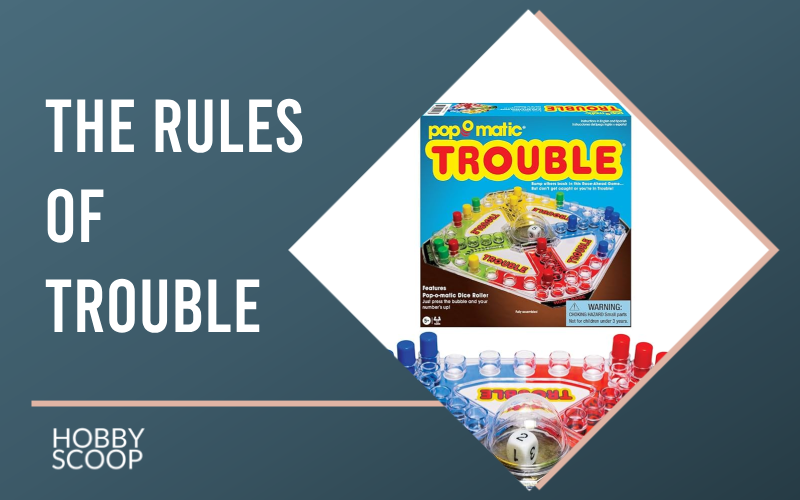
Trouble is one of the most recognizable board games ever made. With its iconic Pop-O-Matic dice roller and simple race-around-the-board gameplay, it’s been a family game night staple since 1965. But whether you just pulled it off the shelf or you’re settling a rules dispute mid-game, knowing the rules of Trouble the board game inside and out makes all the difference.
The Quick Answer: Roll a 6 to move a peg out of Home, then race clockwise around the board. Land on an opponent’s peg to send them back to Home. First player to get all four pegs into the Finish zone wins. Rolling a 6 earns you an extra turn.
Below we’ll cover every rule in detail—including the differences between older and newer versions that cause the most arguments at the table.
A Brief History of Trouble
Trouble was designed by Frank Kohner, Paul Kohner, and Fred Kroll, and first published by the Kohner Brothers company in 1965. It was later produced by Milton Bradley and is now owned by Hasbro. The game is based on the ancient Indian game Pachisi (also the basis for Ludo), but Trouble’s defining innovation was the Pop-O-Matic bubble—a sealed dome containing the die that players press to roll. This solved the age-old problem of dice flying off the table or being “accidentally” nudged, making it perfect for younger players.
What You Need to Play Trouble
- Players: 2–4
- Ages: 5 and up
- Play time: 30–45 minutes
- Components: Game board with built-in Pop-O-Matic die roller, 16 pegs (4 each in red, blue, green, and yellow)
Objective of Trouble
The goal of Trouble is simple: be the first player to move all four of your pegs from your Home base, around the entire board, and into your Finish zone. Along the way, you can bump opponents back to their Home—and they can do the same to you.
How to Set Up Trouble
- Place the board in the center of the playing area so all players can reach the Pop-O-Matic.
- Choose colors: Each player picks a color (red, blue, green, or yellow) and places their four pegs in the matching Home area in one corner of the board.
- Determine first player: In newer versions, the youngest player goes first. In older versions, everyone pops the die and the highest number starts. Play then passes clockwise.
Tip for 2 players: Each player can control two colors for a more strategic and engaging game.
How to Play Trouble: Complete Rules
On your turn, press the Pop-O-Matic bubble to roll the die. What you do depends on the number you roll:
Rolling a 6 — Start a Peg or Move Forward
A 6 is the most important roll in Trouble. You have two options:
- Move a peg from Home to your Start space — This gets a new peg into play. However, you cannot do this if one of your own pegs is already on your Start space. If an opponent’s peg is on your Start space, it gets sent back to their Home.
- Move any peg on the board forward 6 spaces.
Either way, rolling a 6 earns you an extra turn. Pop the die again and take another action. However, if you roll a second 6, you do not get a third turn—two rolls is the maximum per turn.
Rolling 2, 3, 4, or 5 — Move Forward
Move any one of your pegs that’s already on the board forward the number of spaces shown on the die. You must move if you can—you cannot choose to skip your turn.
Rolling a 1 — Rules Vary by Version
This is where many family arguments start, because the rule for rolling a 1 has changed over the years:
- Older versions (pre-2013): A 1 simply moves one of your pegs forward one space, just like any other number.
- Newer versions (2013+): Rolling a 1 is a special event. You do nothing on your turn. Instead, every other player gets to move one of their pegs from Home to their Start space. If a player already has their own peg on their Start space, they don’t get to bring one out. If an opponent’s peg is on their Start space, it gets bumped back to Home.
Check which version you have before starting—this rule alone can dramatically change gameplay.
Can’t Move? Forfeit Your Turn
If you roll a number but have no legal moves (for example, all your pegs are in Home and you didn’t roll a 6), your turn is over. Play passes to the next player.
Bumping Opponents
This is where Trouble gets its name. If you land on a space occupied by an opponent’s peg, their peg is sent back to their Home. They’ll need to roll another 6 (or benefit from a 1 in newer versions) to get that peg back into play.
There are no safe spaces on the main board in Trouble. Any peg on the track can be bumped at any time. The only safe zone is the Finish area.
Landing on Your Own Peg
You cannot land on a space occupied by one of your own pegs. If your roll would place you on your own peg, you must move a different peg instead. If no other move is possible, you forfeit your turn.
However, you can jump over your own pegs while counting spaces—you just can’t end your movement on them.
Special Spaces: Double Trouble
Newer versions of the Trouble board include Double Trouble spaces—marked spaces located where two color sections of the board meet. If you land on a Double Trouble space, you get an extra turn, just like rolling a 6.
However, the maximum of two rolls per turn still applies. If you rolled a 6 and landed on a Double Trouble space, you only get one additional roll, not two.
The Finish Zone: How to Win Trouble
After traveling all the way around the board, your pegs turn into the Finish zone—a column of spaces leading toward the center of the board in your color’s section.
The rules for entering the Finish zone have changed between versions:
- Older versions: You must land on each Finish space by exact count. If you roll a 5 but only need 3 spaces to reach the next open Finish spot, you cannot move that peg. You can use future turns to move pegs further up the Finish track, but never backward.
- Newer versions: Exact count is not required. As long as your roll takes you into (or past) the Finish zone, you place your peg in the open Finish space closest to the center.
Once a peg reaches the Finish zone, it is completely safe—no opponent can bump it. The first player to get all four pegs into their Finish zone wins!
Trouble Rules Summary Table
| Rule | Older Versions | Newer Versions (2013+) |
|---|---|---|
| Rolling a 1 | Move a peg forward 1 space | All other players move a peg from Home to Start |
| Rolling a 6 | Move peg out of Home OR move 6 spaces + extra turn | Same |
| Double Trouble spaces | Not present | Land on one = extra turn |
| Entering Finish zone | Exact count required | Exact count NOT required |
| Max rolls per turn | 2 (rolling a 6 gives extra turn) | 2 (same limit applies) |
| Who goes first | Highest roll | Youngest player |
Strategy Tips for Winning Trouble
Trouble is largely a game of luck, but smart decisions at key moments can give you an edge:
- Get multiple pegs out early. Having more pegs on the board gives you more options each turn. Don’t just advance one peg while the others sit in Home.
- Bump strategically. If you have a choice between advancing safely or bumping an opponent back to Home, consider the bump—especially if they’re close to their Finish zone. Sending a peg back when it’s nearly home is devastating.
- Spread your pegs out. Clustering your pegs close together limits your options and makes it more likely you’ll have to forfeit a move because you’d land on your own peg.
- Watch the board behind you. Before moving a peg forward, check if an opponent could land on your new position on their next turn. Sometimes it’s safer to move a different peg.
- Rush the Finish in newer versions. Since exact count isn’t required in modern rules, get pegs into the Finish zone as quickly as possible rather than hanging back.
Trouble vs. Ludo vs. Sorry! — What’s the Difference?
Trouble, Ludo, and Sorry! are all based on the ancient Indian game Pachisi, but each has its own personality:
- Trouble uses the Pop-O-Matic die roller (one die), has no safe spaces on the main track, and is the simplest of the three. Best for younger kids and quick games.
- Ludo uses a standard die, has safe spaces, and requires exact count to finish. It’s the most traditional version, widely played internationally.
- Sorry! uses cards instead of dice, includes special moves like swapping positions and sliding, and has safe zones. It has the most strategy of the three.
If you enjoy Trouble, trying other family board games like Sorry! or Ludo can add variety to game night.
Different Versions of Trouble
Classic Trouble (1965–present)
The original version that started it all. Four colors, Pop-O-Matic, simple race-and-bump gameplay. The rules have been tweaked over the decades (as noted above), but the core experience remains the same.
Trouble with Power Die & Shield (2024)
The newest version adds a second die—the Power Die—which introduces shields (protecting pegs from being bumped) and other power-ups. This adds an extra layer of strategy to what was previously a pure luck game.
Double Trouble / Warp Spaces (2013–2016)
These versions introduced Double Trouble bonus spaces and Warp spaces that let you teleport to different parts of the board. The warp feature was removed in later editions but remains popular with fans—older copies can sometimes be found on eBay.
Themed Editions
Hasbro has released numerous themed versions including Star Wars, Frozen, Marvel, and other franchise editions. These feature custom character pegs and themed boards but follow the same core rules.
Travel Trouble
A compact, portable version designed for playing on the go. Same rules, smaller board.
Frequently Asked Questions
Do you need an exact roll to get into the Finish zone?
It depends on your version. Older versions require exact count—you must roll the precise number needed to land on a Finish space. Newer versions don’t require exact count; any roll that takes you into or past the Finish zone lets you place your peg in the next open Finish spot.
Can you jump over your own pegs?
Yes. You can count through spaces occupied by your own pegs while moving—you just can’t end your movement on a space occupied by your own peg.
What happens if you can’t move any piece?
Your turn is over. This typically happens when all your pegs are in Home and you didn’t roll a 6, or when your only possible moves would land on your own pegs.
Can you land on your own piece in Trouble?
No. You must move a different peg or forfeit your turn if no other legal move exists.
What does rolling a 1 do in newer versions of Trouble?
In versions from 2013 onward, rolling a 1 means you do nothing—but every other player gets to move one peg from their Home to their Start space. This rule doesn’t exist in older versions, where a 1 simply moves a peg forward one space.
How many times can you roll in one turn?
A maximum of two times. You get an extra roll from rolling a 6 or landing on a Double Trouble space, but never a third roll in the same turn.
Is Trouble the same as Ludo?
They’re related but not identical. Both are based on the ancient game Pachisi, but Trouble uses a Pop-O-Matic die roller, has no safe spaces, and has simpler rules. Ludo uses a standard die, has designated safe spaces, and typically requires exact count to finish.
What are the arrows on the Trouble board for?
The arrows near the Start spaces simply indicate the direction of movement (clockwise). They don’t have any special gameplay effect.
Final Thoughts
Understanding the rules of Trouble the board game takes just a few minutes, but the game has kept families entertained for over 60 years. Its beauty lies in its simplicity—pop the die, move your peg, and try not to get bumped. Whether you’re playing the classic version or the latest edition with power dice, the thrill of sending an opponent’s peg back to Home never gets old.
The biggest thing to remember: check which version you’re playing. The rules for rolling a 1 and entering the Finish zone differ between editions, and sorting this out before you start will save you from mid-game debates.
Now pop that die and get playing! 🎲
Looking for more classic game rules? Check out our guides to UNO rules, Monopoly rules, and Dominoes rules. Or explore our picks for the best family board games for your next game night.